

I love Pilates.
I also lift weights.
Not because Pilates isn’t supportive, but because Pilates and strength training do different things for the body.
When you understand this, your workout routine becomes simpler, efficient, and more effective.
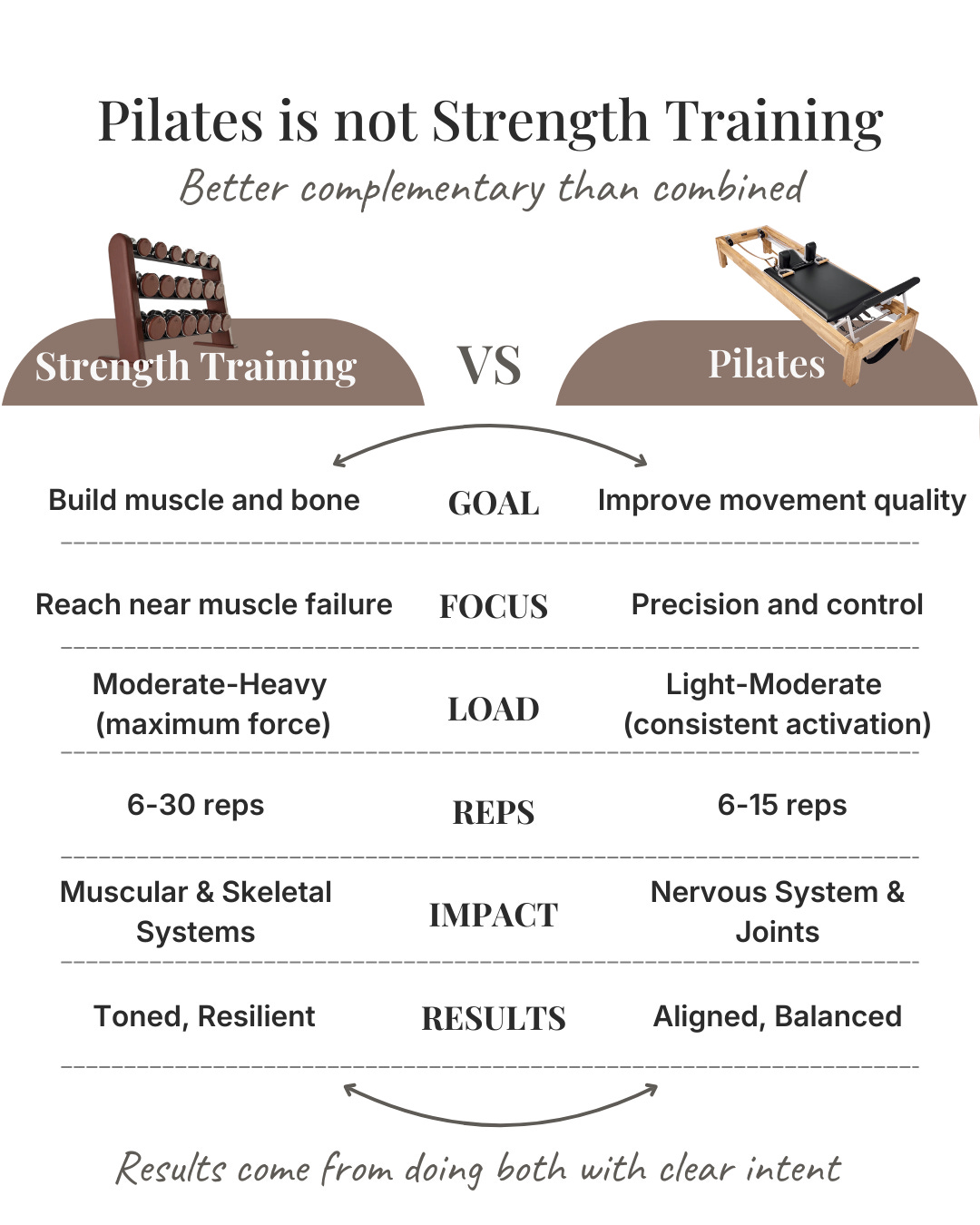
But Pilates can be strength training, right?
Not for most people
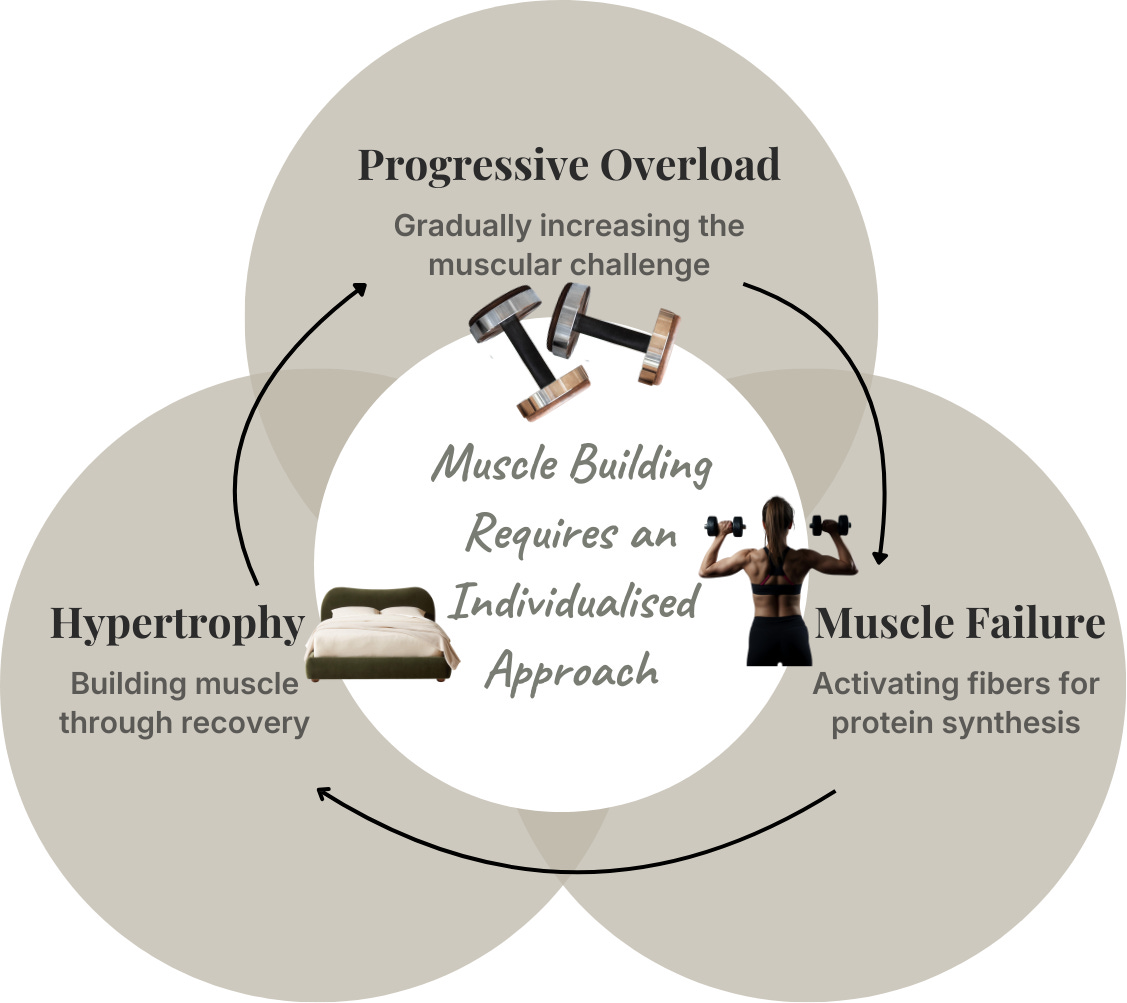
Building muscle requires a highly individualised approach:
Specific load
Specific reps
Specific progression
Specific range of motion
Group Pilates classes aren’t designed for this level of personalisation. They can be strength training if the biomechanics and loading match your specific needs, but most classes cant support this in depth.
This is why I recommend my clients let Pilates be Pilates. Let strength training be strength training. And allow them to complement each other.
My Weekly Workout Routine (Simple, Sustainable)
As a Pilates instructor with a background in health science, I utilise principles of exercise physiology to strategise and approach my workout routine:
Strength training builds muscle, pilates improves how well you use that muscle. Doing both, but separately, gets better results.
3× / week — 30 min strength training
Goal: Training near muscle failure
Method: Progressive overload with weights divided into upper body, lower body, and full body sessions
2× / week — 50 min Pilates
Goal: Improve precision and control of movement
Method: mat or apparatus
This routine supports my muscles, bones, joints, and long-term health without burnout.
Strength Training 3x/week - build and keep muscle
The goal of strength training is to build and keep muscle to support your bones and long term mobility.
Muscle doesn’t grow because you “feel the burn” in a workout, it grows because the body receives a distinct signal it needs to synthesise protein to grow thicker muscle fibers and get stronger.
This signal has three parts:
1. Progressive Overload
Progressive overload is consistently challenging your muscles to do more than they’re used to, giving your body a reason to respond and change.
In weight lifting, this can be achieved by:
Increasing the weight (load)
Adding reps or sets
Utilising a more challenging range of motion
The biggest mistake I see people make is going too heavy, too fast. I design my 30-minute lifting sessions around simple, targeted exercises so I can effectively track progress and continue to challenge my muscles without causing injury.
Why lifting supports progressive overload better than a Pilates class:
Pilates isn’t designed to progressively overload muscles, it’s designed to work the spine in a variety of ways
Increasing the load in a pilates class is difficult unless you know how biomechanics operate, weight lifting allows you to precisely measure, track, and progress the weight, reps and sets
2. Training to near muscle failure
Muscle is made of many fibers. For it to grow it has to work hard enough so most of the fibers are recruited, which then triggers protein synthesis to fuel muscle building.
I explain it to my clients this way:
Your muscles are made of many “helpers” (fibers)
When the job is easy → only a few helpers are needed
When the job gets hard → more helpers come in
When the job is seemingly impossible → almost all helpers jump in
You don’t need to make the helpers collapse on the floor, just hard enough so they think “wow, that was tough.”
This is not about:
Exhaustion
Shaking
Being drenched in sweat
Those are sensations, not signals.
It’s about giving the muscle a clear, local challenge.
Why lifting supports nearing muscle failure better than a Pilates classes:
Pilates isn’t designed to train near failure, it’s designed for consistent activation to maintain precision and control
Typically it takes 6-30 reps to get to failure, on average a Pilates exercise is 6-15 reps
3. Hypertrophy
Muscle fibers don’t grow during training, they grow in recovery. This process is called hypertrophy.
Hypertrophy happens through:
Sleep
Eating nutritiously
Adequate rest between sessions
Being sore and exhausted all the time is actually preventing you from building muscle. Recovery makes results attainable and sustainable.
My recovery days include:
Walking
Active stretching
Gentle mobility
I want to make sure I’m rested so muscle actually grows, fatigue clears, and motivation stays high.
Pilates 2x/week - deepen movement quality
Pilates focuses on the quality of movement, not how much force you produce.
Rooted in rehab and restoration, Pilates uses fewer reps, less momentum, and more coordinated movement to:
Build mind–muscle connection
Improve movement precision and control by engaging deeper “stabiliser” muscles
Support joints and stability
It strategically improves how your body uses what you already have by focusing on adapting the nervous system and joints.
Nervous System:
The mind-muscle connection in Pilates is essential. Your brain gets better at telling the right muscles to do the work, resulting in…
Better muscle recruitment
Improved coordination and timing
Less unnecessary tension
Joints:
Since pilates is rooted in rehab and restoration, the exercises are designed to:
Improve joint positioning and stability
Increase movement control and range
Evenly distribute load for balance
When I do Pilates I’m not focused on maximum force to reach muscle failure, I’m concentrating on precise movements that support the spine and core for alignment and balance.
Why I Don’t Combine Strength Training and Pilates Into One Session
Trying to do everything at once:
Reduces how close I can train to muscle failure and build muscle
Increases exhaustion without increasing stimulus
Makes progress harder to measure and track
Blurs the goal of the session
When you separate their roles, they actually enhance each other by:
Improving joint positioning under load
Helping you recruit the targeted muscle, and reducing overcompensation by non-targeted muscles
Supporting recovery between sessions to maintain a consistent, results focused workout routine
If this reframes how you think about Pilates or strength training, I’d love to hear your thoughts. Feel free to leave a comment or ask questions, especially if you’re navigating how to balance both in your own routine.


so informative!!